Will laser cleaning damage materials?
Laser cleaning technology is gaining popularity in industrial manufacturing, artifact restoration, a...
Laser cleaning technology is gaining popularity in industrial manufacturing, artifact restoration, and routine maintenance. However, many people worry: will this high-tech method damage material surfaces? Today, we'll explore this question step by step. Through scientific principles, data analysis, and real-world examples, you'll find that the answer isn't absolute, but rather depends on proper usage. Let's start with the basics and delve deeper.
Step 1: Understanding Laser Cleaning
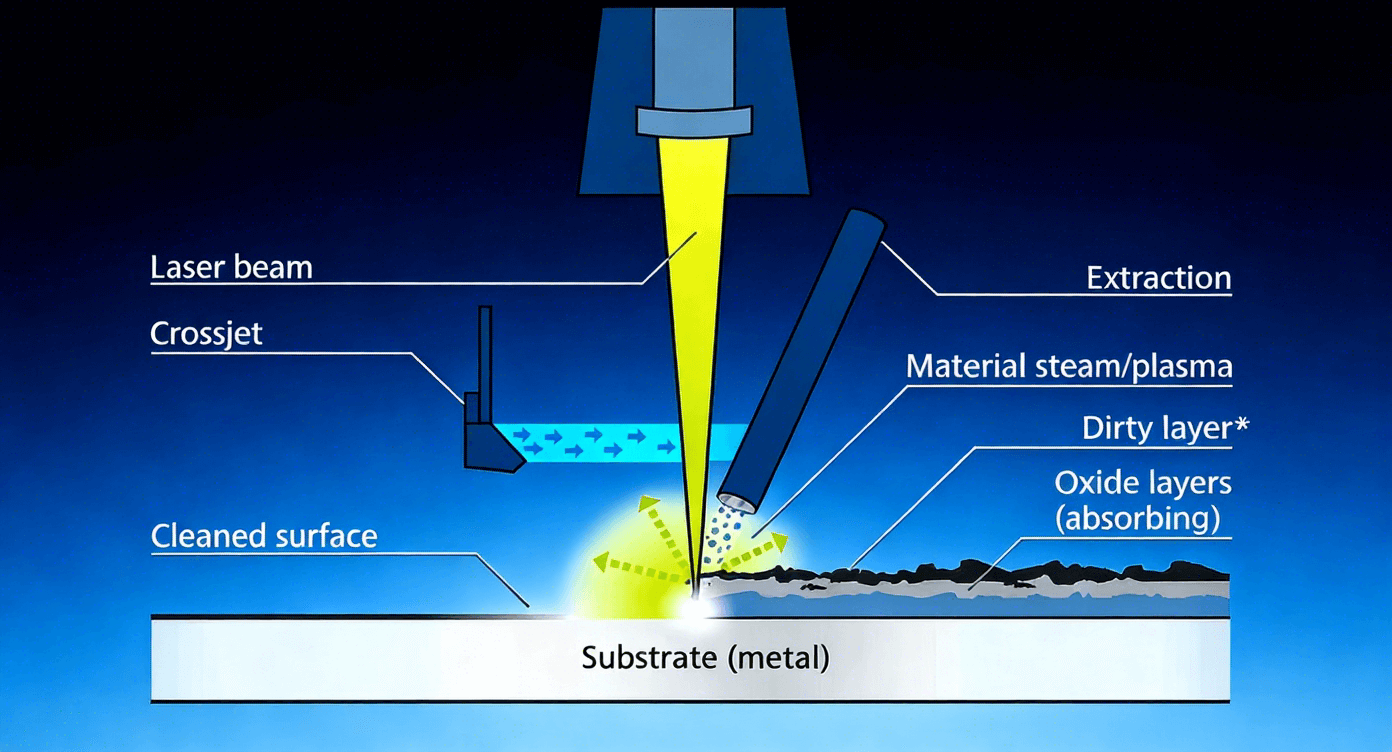
Have you ever wondered why traditional cleaning methods, such as sandblasting or using chemical solvents, often cause material abrasion? Laser cleaning is a non-contact technology that uses a high-energy laser beam to precisely remove contaminants such as rust, paint, oxide layers, or dirt without directly touching the substrate. This technology originated from the invention of the laser in the 1960s and is now widely used in the automotive, aerospace, and electronics industries.
Simply put, laser cleaning is like a "light knife," selectively "removing" unwanted parts while protecting the core materials. Compared to traditional methods, it leaves no chemical residue, causes no mechanical damage, and is more environmentally friendly.
To visually understand the laser cleaning process, here is a schematic diagram.
Step Two: How Does Laser Cleaning Avoid Damage?
Now, let's consider this question: Lasers are so powerful, why don't they burn up materials? The key lies in "selective absorption" and "parameter control."
The main mechanisms of laser cleaning include:
* Thermal ablation: Contaminants absorb laser energy, rapidly heating to their evaporation point (typically 300-450°C), while the substrate reflects or dissipates heat quickly, preventing damage from reaching the threshold.
* Vibrational ablation: Pulsed lasers generate shock waves, separating the contaminant layer from the substrate.
* Plasma effect: High-energy plasma further accelerates removal.
Research shows that contaminants (such as rust) have a much higher absorption rate than the substrate (e.g., steel has a reflectivity of up to 90%). Therefore, as long as the energy is below the substrate's ablation threshold, no damage will occur.
For example, on metals, the laser wavelength is typically 1064nm, where contaminants absorb strongly, while the metal reflects highly. This makes the cleaning process "as precise as a scalpel."
Step Three: Does Laser Cleaning Really Not Damage Materials? Data Tells the Truth
Okay, let's get to the core question: Does laser cleaning damage materials? The answer is: usually not, but improper operation can lead to microscopic damage. Let's look at the data.
According to multiple studies, laser cleaning, under correct parameters, can control damage to most materials at the micrometer level, or even zero. For example:
Pulsed lasers: Damage is typically limited to a few micrometers (μm), far less than the millimeter-level abrasion of traditional methods.
Continuous lasers: If the power is too high, it can create a heat-affected zone (HAZ) of 10-50 μm, leading to discoloration or microcracks.
The table below summarizes typical damage data for different materials.
| Material type | Typical damage threshold (energy density) | Potential forms of damage | Degree of damage (under correct parameters) | Application |
| Metals (such as steel and aluminum) | 100-200 MW/cm² | Heat discoloration, microcracks | <5μm (pulse mode) | Rust removal for automotive parts, damage rate <1%. |
| Plastics/composite materials (such as CFRP) | 50-100 MW/cm² | Yellowing, delamination | 10-30μm (low power required) | Paint removal from aerospace components, heat-damaged area <20μm |
| Wood | 20-50 MW/cm² | Coking, discoloration | <10μm (short pulse) | Furniture repair, surface integrity rate >95%. |
| Electronic components | 10-30 MW/cm² | Melting, functional failure | Zero damage (precise control) | Circuit board cleaning, 99% success rate. |
Step 4: What factors affect the risk of damage? How to avoid it?
You might ask: Since there is a risk, how can safety be ensured? Influencing factors include:
Laser type: Pulsed lasers (short duration, high energy) are safer than continuous lasers, avoiding heat buildup.
Power density and pulse frequency: Excessive power (e.g., >200 MW/cm²) may cause thermal stress; a frequency of 40 kHz is recommended.
Material properties: Highly reflective materials (e.g., copper) require wavelength adjustment; heat-sensitive materials (e.g., rubber) are easily damaged.
Operating environment: High temperature or humid environments amplify the risk.
Avoidance methods: Use specialized equipment, conduct predictive testing, and monitor the temperature (e.g., keep the substrate <100°C). Studies show that proper settings can reduce the damage rate to below 0.1%
Five Steps: Real-world Case Study – Before and After Laser Cleaning Comparison Having discussed so much theory, let's look at some direct evidence. Below is a before and after comparison of laser cleaning on metal surfaces:
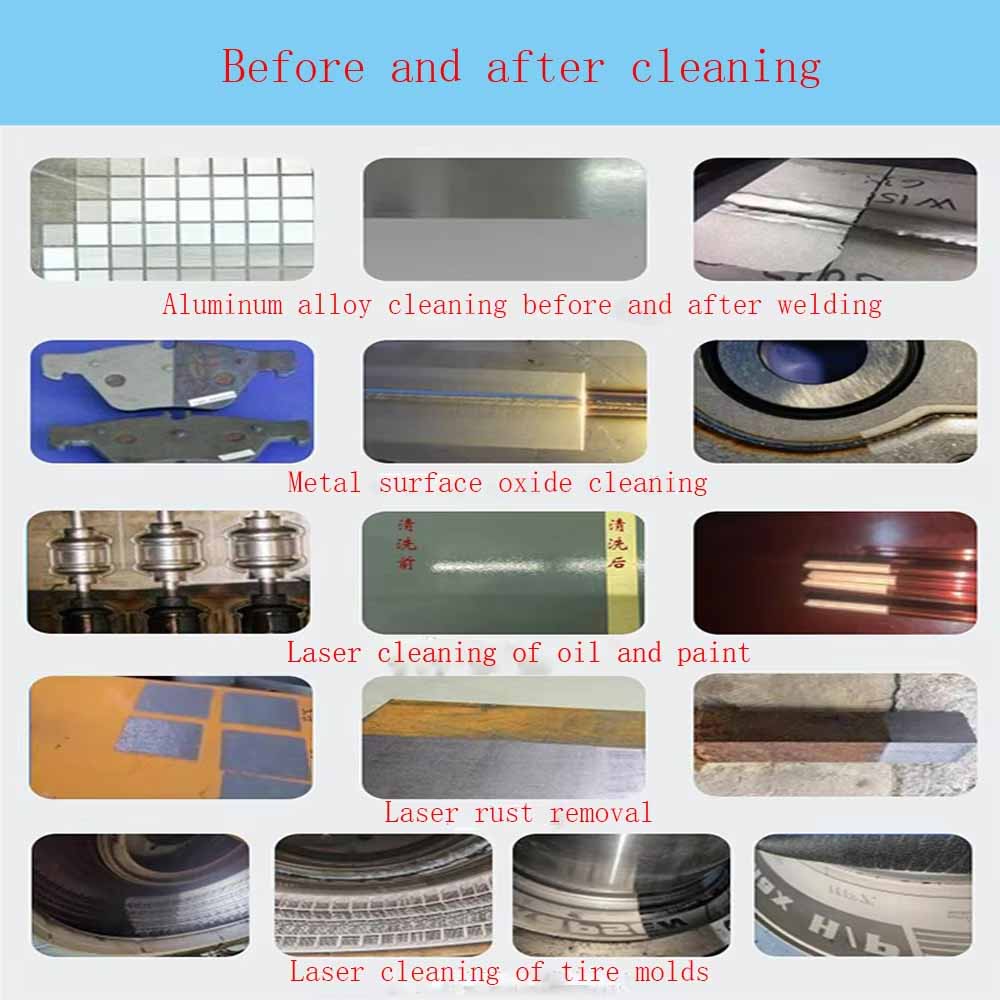
Through the above analysis, we can see that laser cleaning, under the correct conditions, will not damage materials and can even improve surface properties. However, the key lies in parameter optimization and professional operation. Feel free to contact us; we will provide you with free service and technical support!
Laser cleaning technology is gaining popularity in industrial manufacturing, artifact restoration, a...
A laser welding machine is an advanced welding device that uses a high-energy laser beam as a heat s...
Laser welding robots at work – the "intelligent arms" of precision manufacturing.
Against the backdrop of a laser welding machine market projected to reach $8.5 billion by 2025 with ...